FREE! Click here to
Join FunTrivia. Thousands of games, quizzes, and lots more!

Wolves Trivia Questions and Answers
Fun Facts & Interesting Information
Fun Trivia Question Usage
You are welcome to use the questions in this section for non-commerical purposes: quizzing friends/coworkers, classrooms, newsletters, trivia nights, events, etc. Questions may
not be used for websites or in apps, and may not be resold. You use the questions at your own risk, and FunTrivia is not responsible for errors, etc in the content.
Please
link to or
credit FunTrivia textually (http://www.funtrivia.com) if you use any of these questions. Thanks!
Visit our
Trivia Question Store to buy question packs for commercial or for-profit ventures.
1. Despite the common name "grey wolf," which color is the most common colors for the species, accounting for about one third of all individuals?
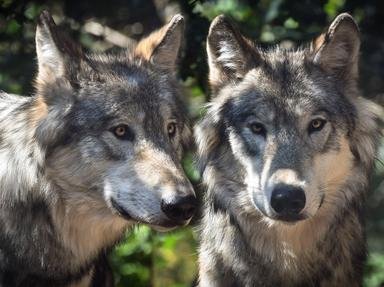
Answer: brown
Interesting Information:Black emerges primarily in forested regions, and white is most common in arctic regions as white wolves thrive best where they can be hidden by the snow. However, a mixed set of browns is the most common color of wolf fur.
Difficulty: Hard.
From Quiz: Baying At the Moon: Return to the Hunt
Some incorrect choices:
black, white, orange
2. What name is given to the most subservient, lowest-ranking wolf in the pack?
Answer: The omega wolf
Interesting Information:Wolf packs are led by an alpha male and his mate, the alpha female. Wolves will usually mate for life.
Difficulty: Hard.
From Quiz: The Majestic Wolf
Some incorrect choices:
The alpha wolf, The beta wolf, The underdog
3. What continent is the maned wolf native to?
Answer: South America
Interesting Information:The maned wolf is native to South America, but mainly in Argentina, Paraguay, Bolivia, Peru. According to http://www.cosmosmith.com/maned_wolves.html, "Ancestors of the maned wolf are thought to have spread from North to South America about two million years ago. Broken away from other wolf species in North America, the maned wolf evolved into what it is today."
Difficulty: Hard.
From Quiz: The Maned Wolf
Some incorrect choices:
Africa, North America, Australia
4. How do wolves greet one another?
Answer: By licking at each other's muzzles.
Interesting Information:A wolf may greet a pack member by licking and nipping at its muzzle. This is typically done to higher ranking wolves.
Difficulty: Easy.
From Quiz: Wolves: Social Behavior
Some incorrect choices:
By howling., By barking., They don't greet one another.
5. One afternoon, my neighbor looked at my wolf pup and asked, "What species is he?" When I told him the scientific name was Canis lupus, he shrugged and said he didn't know much about wolves. Which of the following is correctly identified as Canis lupus?
Answer: Gray Wolf
Interesting Information:The gray wolf is a powerful and intelligent predator, known for its loyalty to family and its ability to survive in some of the world's harshest environments. It lives in social groups called packs, where every member, from pups to elders, has an important role.
Gray wolves often travel long distances to track prey, using a mix of endurance, teamwork, and keen senses. Their presence in an ecosystem helps control herbivore populations and keeps landscapes healthier. Although legends portray them as fearsome, wolves usually avoid people and focus on maintaining the natural balance of the wild.
Difficulty: Hard.
From Quiz: Why I Adopted a Wolf
Some incorrect choices:
Red Wolf, White Wolf, Ethiopian Wolf
6. An average German Shepherd dog can exert 750lbs of pressure per square inch of jaw. How much pressure can a wolf's jaws exert per square inch?
Answer: 1500lbs
Interesting Information:This is part of the reason that it can be dangerous to own a wolf-dog hybrid. A bite from one of these animals could be extremely dangerous. They can seem like wonderful and loyal pets but they will remain innately wild and can therefore be highly unpredictable.
Difficulty: Hard.
From Quiz: Wolves
Some incorrect choices:
1000lbs, 2000lbs, 1300lbs
7. In what areas of the world are wolves the largest?
Answer: high northern latitudes
Interesting Information:Like many wide-ranging animals, wolves are largest in Arctic regions, as are their prey. The bison that wolves hunt in Canada and the United States are largest in northern Canada as well. The prey the Siberian wolves hunt is also large and so are they.
Difficulty: Hard.
From Quiz: Baying At the Moon: Return to the Hunt
Some incorrect choices:
middle latitudes, subtropical latitudes, wherever they are closest to human cities
8. What is the primary purpose of an omega wolf in the pack?
Answer: to relieve stress
Interesting Information:While the omega wolf may take on the job of watching cubs or may patrol with the rest of the pack, they primarily serve as a stress outlet for the rest of the pack. They often do this by initiating play. If you have a playful dog at home that always wants to play, it is because centuries of domestication have led many dogs to automatically see themselves as omega members of their families.
Difficulty: Hard.
From Quiz: Baying at the Moon
Some incorrect choices:
to take the greatest risks during hunts, to watch cubs, to patrol the pack's territory
9. What is the maned wolf's nickname?
Answer: The stilt-legged fox
Interesting Information:The maned wolf resembles a stilt-legged fox. It is around 3 feet high, and weighs around 50 pounds, with most of that height coming from the legs. It's also a beautiful red color, with black and white highlights, much like the red fox.
Difficulty: Hard.
From Quiz: The Maned Wolf
Some incorrect choices:
The long-legged wolf, The fox-wolf, The stilt-legged red wolf
10. How long can a gray wolf go without food?
Answer: 2 weeks or longer
Interesting Information:Gray wolves can also consume as much as 20 pounds of food at once.
Difficulty: Hard.
From Quiz: The Life Of Gray Wolves
Some incorrect choices:
1 day, A few days, 1 week
11. My neighbor once asked me how much a healthy grown wolf eats, and confidently said, "I bet it's definitely less food than what my German Shepherd can eat, since wolves don't require much to stay healthy and reproduce." Is that true or false?
Answer: False
Interesting Information:A healthy German Shepherd usually eats around 1.5 to 2.5 pounds (0.68-1.13 kg) of food daily, depending on size and activity. A healthy grown wolf, however, requires much more, especially when preparing to breed or raise pups. Although a wolf can survive on roughly 2.5 pounds (1.13 kg) during hardship, it needs closer to 5 pounds (2.27 kg) a day to stay in breeding condition. After a successful hunt, wolves often gorge, sometimes consuming 10 to 20 pounds (4.54-9.07 kg) in one meal to build energy reserves.
Difficulty: Hard.
From Quiz: Why I Adopted a Wolf
Some incorrect choices:
----------, ----------, ----------
12. While we're still talking about the omega wolves, what torment do they not have to face?
Answer: physical harm from other pack members
Interesting Information:The omega wolf of any pack is generally harassed, chased, and starved when the pack falls on hard times, but despite the ferocious reputation of wolves, there is little violence within a pack, even to the omega.
Difficulty: Hard.
From Quiz: Baying at the Moon
Some incorrect choices:
getting the least amount of food, being intimidated by other pack members, not being allowed to mate
13. Why do wolves howl?
Answer: All of these.
Interesting Information:Howling is the most iconic symbol of the grey wolf and of wilderness in general, capable of sending a shiver down anyone's spine. Did you know that when several wolves are howling together, they all howl at different pitches? If you replicate the pitch of a wolf's howl, it will quickly switch so that no two pitches are ever alike. It is thought that this is to enable rival packs to hear exactly how many wolves there are howling.
Difficulty: Easy.
From Quiz: The Majestic Wolf
Some incorrect choices:
To make sure rival packs know they're there., To call together separated members of the same pack., Because they enjoy it.
14. Is the maned wolf nocturnal (sleeps during the day and is awake at night) or diurnal (sleeps at night and is awake during the day)?
Answer: Nocturnal
Interesting Information:The maned wolf is a nocturnal omnivore, which means that it's asleep during the day and hunts during the night.
Difficulty: Hard.
From Quiz: The Maned Wolf
15. How many teeth do gray wolves have?
Answer: 42
Interesting Information:They have 4 fangs that measure up to 2 inches. Their front teeth are used to cut their prey's skin and the back are used to cut bone.
Difficulty: Hard.
From Quiz: The Life Of Gray Wolves
Some incorrect choices:
51, 46, 34
16. When are wolf pups born?
Answer: In the spring.
Interesting Information:Wolf pups are always born in the spring, and there are typically 4-6 pups born in a litter, but sometimes as many as 10.
Difficulty: Hard.
From Quiz: Wolves: Social Behavior
Some incorrect choices:
In the winter., In the autumn., Anytime of the year.
17. While walking with his German Shepherd outside, my neighbor told me, "I heard wolves can walk incredibly long distances in the forest while searching for food, like thirty or even forty miles (around fifty to sixty km)". Is what he said true or false?
Answer: True
Interesting Information:Wolves are made for long journeys. They usually trot along at about 5 miles an hour (8 km/h), keeping up that pace for hours as they follow scents and tracks. On most days, they'll cover 10 to 30 miles (16 to 48 km) looking for food.
If prey is scarce or the pack is moving to a new area, they can travel as far as 40 miles (64 km) in a single day. This constant roaming is why wolves need big territories and why they know every stream, hill, and wind pattern in the places they live.
Difficulty: Hard.
From Quiz: Why I Adopted a Wolf
Some incorrect choices:
----------, ----------, ----------
18. The following are NOT wolves except one. Which one is it?
Answer: Canis lupus signatus.
Interesting Information:Canis lupus familiaris is the Dog throughout the world. The other two are fox species. Canis lupus signatus is known as the Iberian Wolf.
Difficulty: Hard.
From Quiz: Canis Lupus
Some incorrect choices:
Canis Lupus familiaris., Otocyon megalotis., Vulpes pallida.
19. What, approximately, is the average birth weight of a wolf pup?
Answer: One pound
Interesting Information:They average about six per litter and open their eyes after roughly one week. A week after that they often start to explore the world outside the den a little.
Difficulty: Hard.
From Quiz: Wolves
Some incorrect choices:
Two pounds, One and a half pounds, Two and a half pounds
20. Although wolves usually flee from people, attacks on humans occasionally occur. In what season is this most likely to happen?
Answer: summer
Interesting Information:Though prey can be scarce in winter, humans rarely encounter wolves in the winter, so most attacks happen when humans are active in the wilderness, particularly in summer.
Difficulty: Hard.
From Quiz: Baying At the Moon: Return to the Hunt
Some incorrect choices:
spring, winter, autumn
21. When wolves howl separately, they are communicating their positions to one another. What does it mean when an entire pack howls together?
Answer: They are declaring their dominance of an area.
Interesting Information:Wolves often work by stealth when they hunt, so startling prey by means of howling would be counterproductive. It is not currently believed that wolves grieve. Also, the mating generally stays within the pack.
Difficulty: Easy.
From Quiz: Baying at the Moon
Some incorrect choices:
They are mourning a dead pack member., They are trying to startle possible prey., They are trying to attract more wolves to join the pack.
22. What adaptation do wolves have to make it easier for them to walk on snow?
Answer: Broad paws to spread their weight evenly.
Interesting Information:A full-grown wolf's paw is about the size of a large man's fist.
Difficulty: Easy.
From Quiz: The Majestic Wolf
Some incorrect choices:
Light-weight bones to stop them from sinking., None - they avoid heavily snowed areas., They run so fast across the snow that they don't sink.
23. In regards to diet (not scientific family!) is the maned wolf a carnivore, an omnivore or an herbivore?
Answer: omnivore
Interesting Information:Interestingly enough, the maned wolf is an omnivore. The fruit "lobeira", which is a tomato-like fruit, consists of half of the wolf's diet. The other half consists of small mammals, reptiles, birds and their eggs, and insects. In one instance, "Captive maned wolves were traditionally fed meat-heavy diets and developed kidney stones."
http://en.wikipedia.org/wiki/Maned_Wolf
Difficulty: Hard.
From Quiz: The Maned Wolf
24. At what age do gray wolves start to eat meat and temporarily leave their den?
Answer: 3 weeks
Interesting Information:They permanently leave the den when they are two months old.
Difficulty: Hard.
From Quiz: The Life Of Gray Wolves
Some incorrect choices:
6 weeks, 3 months, 2 months
25. After a quick jog, my neighbor laughed and said, "At full speed, my German Shepherd could make your wolf look like it's standing still." "But can he really?", I thought. Who actually has the higher top speed?
Answer: My Wolf
Interesting Information:German Shepherds are fast dogs, often reaching top speeds of around 20 to 30 miles per hour (32 to 48 km/h), depending on training and build. Wolves, however, are built for both power and endurance. During a chase, a gray wolf can burst up to 35 to 40 miles per hour (56 to 64 km/h), giving it a clear advantage over most domestic dogs.
Although wolves rarely sustain this speed for long, the combination of their long legs, deep chest, and powerful muscles makes their sprint significantly faster. While German Shepherds excel at agility and quick acceleration, wolves dominate in raw top speed and distance-covering ability.
Difficulty: Hard.
From Quiz: Why I Adopted a Wolf
Some incorrect choices:
His Dog, ----------, ----------
26. Wolves are in the Class Mammals, the Order Carnivora. In which family of Order Carnivora are they classified?
Answer: Canidae.
Interesting Information:The family is represented by 14 genera and 34 species. Canids are widely distributed, occurring on all continents except Antarctica, and it is the only member of the Order Carnivora that is represented in Australia (Canis Familiaris Dingo.)
Difficulty: Easy.
From Quiz: Canis Lupus
Some incorrect choices:
Procyonidae., Ursidae., Hyaenidae.
27. What was the name of the large species of wolf native to North America that became extinct roughly ten thousand years ago?
Answer: Dire wolf
Interesting Information:The first dire wolf fossils were found on the banks of the Ohio River. These wolves were around twenty percent larger than most living species of grey wolf.
Difficulty: Hard.
From Quiz: Wolves
Some incorrect choices:
Giant wolf, Dour wolf, Great wolf
28. A charming quirk of wolf behavior is that a certain weather event triggers a major urge to play in wolves. What weather event is it?
Answer: snow
Interesting Information:Surviving in many breeds of domesticated dog, wolves often are elated by snow and the whole pack is rather playful when it snows.
Difficulty: Hard.
From Quiz: Baying At the Moon: Return to the Hunt
Some incorrect choices:
rain, sunshine, the northern lights
29. During mating season, the alpha wolf and his mate are unusually harsh and violent to the rest of the pack. Why?
Answer: The stress prevents the other wolves from mating.
Interesting Information:Animals under severe stress stop producing hormones necessary for reproduction. The violence is not severe enough to cause any deaths, but the fact that only one pair of wolves in each pack breeds means that the pack does not get too large, too fast.
Difficulty: Hard.
From Quiz: Baying at the Moon
Some incorrect choices:
They want to create violence so the pack will be small when the new cubs are born., The reason is unknown., They need more food and so they want to increase the pack's aggression.
30. In what season do newly adult gray wolves start to hunt with other adult wolves?
Answer: Fall
Interesting Information:The newly adult gray wolf spends nearly all summer in a rendezvous site.
Difficulty: Hard.
From Quiz: The Life Of Gray Wolves
Some incorrect choices:
Spring, Summer, Winter
31. How are wolf pups brought up?
Answer: The entire pack assists in the upbringing.
Interesting Information:The entire group will assist in raising the pups. They help to feed the mother and pups with food from the hunt, protecting the area from large predators such as grizzly bears, and acting as nursemaids when the mother goes hunting.
Difficulty: Easy.
From Quiz: Wolves: Social Behavior
Some incorrect choices:
They're left to fend for themselves., Only the pups' mother., Both the pups' mother and father.
32. Later that night, while cleaning his German Shepherd's teeth, my neighbor chuckled and said, "At least my dog has much more teeth than your wolf ever will." Is that true or false?
Answer: False
Interesting Information:Adult gray wolves actually have 42 teeth, which is roughly the same as in a German Shepherd. Every part of a wolf's mouth is built for survival, long canines for gripping prey, razor-sharp carnassials for slicing meat, and strong molars for crushing bone. These teeth let wolves take down large animals and process tough food sources that pet dogs never encounter.
Domestic dogs, by comparison, have teeth shaped for a more varied diet and far less demanding work. So while the neighbor was joking, the wolf is the real heavyweight in the teeth department.
Difficulty: Hard.
From Quiz: Why I Adopted a Wolf
Some incorrect choices:
----------, ----------, ----------
33. Approximately how much meat does an adult wolf need to consume each day to remain healthy?
Answer: Two and a half pounds
Interesting Information:This is the equivalent of roughly eighteen adult deer per wolf each year. However, this amount increases to roughly five pounds per day in female wolves who are pregnant or lactating.
Difficulty: Hard.
From Quiz: Wolves
Some incorrect choices:
One and a half pounds, Four pounds, Five and a half pounds
34. If one were to encounter a wolf pack while hiking most times during the year, what is the most likely reaction the pack would have?
Answer: It would run away.
Interesting Information:In reality, wolves are very easily frightened and avoid humans and places where humans tend to be. Only when the pack is on the verge of utter starvation will they become bold enough to attack a human being.
Difficulty: Hard.
From Quiz: Baying at the Moon
Some incorrect choices:
It would attack., It would continue to shadow the person it encountered., It would make a lot of noise to frighten the person, but wouldn't attack.
35. Which types of bird do wolves seem to have a special relationship with?
Answer: Ravens and crows
Interesting Information:Ravens and crows often follow wolf packs around in the hope of scavenging a meal from their leftovers, but the arrangement seems to be beneficial to the wolves as well. If the birds find an animal corpse somewhere, they will alert the wolves and lead them to it. The wolves get a meal and so do the birds, who would never have been able to get through the tough hide to eat the flesh if it weren't for the wolves' sharp teeth.
Difficulty: Hard.
From Quiz: The Majestic Wolf
Some incorrect choices:
Bluejays and pigeons, Bald eagles and ospreys, Owls
36. What are wolves who leave the pack called?
Answer: Dispersers
Interesting Information:Wolves even have different personalities. Many are very social animals, some are natural leaders, while others are "lone wolves". Dispersers are wolves which leave their pack and go out in search of a mate and new territory.
Difficulty: Hard.
From Quiz: Wolves: Social Behavior
Some incorrect choices:
Loners, Rogues, Anarchists
37. Next morning we met on our usual walk, and my neighbor proudly said, "German Shepherds are the best sniffers in the animal world, and your wolf probably can't smell anything from much farther than my dog can." Is what he said true or false?
Answer: False
Interesting Information:German Shepherds have excellent noses and are often trained for detection work, but wolves still outperform them in long-distance scent tracking. A wolf's sense of smell is incredibly powerful, allowing it to detect prey from over a mile away, often around 1.5 miles (roughly 2.4 km) under good wind and open ground. Wolves rely heavily on scent to locate herds, follow trails, and communicate across vast territories. Their nasal passages, larger olfactory system, and wild adaptation give them a significant advantage. German Shepherds excel in precision at close range, but wolves dominate when it comes to detecting scents across great distances.
Difficulty: Hard.
From Quiz: Why I Adopted a Wolf
Some incorrect choices:
----------, ----------, ----------
38. To how many pups does a female Red Wolf usually give birth?
Answer: 3-4
Interesting Information:Breeding occurs in January and February, with birth of 3-4 pups in March and April.
Difficulty: Hard.
From Quiz: Canis Lupus
Some incorrect choices:
1-2, 5-6, 8
39. Over approximately what distance can wolf howls be heard, provided there are no obstructions, such as hills or mountains, in the way?
Answer: Up to ten miles
Interesting Information:Although this obviously depends a great deal on the terrain, weather conditions and other variables, wolf howls have been heard as much as ten miles away from their source before.
Difficulty: Hard.
From Quiz: Wolves
Some incorrect choices:
Up to seven miles, Up to three miles, Up to fifteen miles
40. What is the scientific name of the maned wolf?
Answer: Chrysocyon brachyurus
Interesting Information:The maned wolf is the only member of the genus "Chrysocyon." Canis simensis is the Ethiopian Wolf, Canis lupus is the Gray Wolf and Vulpes vulpes is the Red Fox.
Difficulty: Hard.
From Quiz: The Maned Wolf
Some incorrect choices:
Canis simensis, Canis lupus, Vulpes vulpes
Please remember to credit FunTrivia.com, add links on your website or newsletters, or otherwise spread the word about our website. Thank you very much, and we hope these questions have been useful!
|