FREE! Click here to Join FunTrivia. Thousands of games, quizzes, and lots more!
Quiz about So Many Stars So Little Time

So Many Stars, So Little Time. Quiz


There is a lot of cool stuff when you look up at the sky at night. Here's a ten question quiz which I hope will pique some interest in all those sparkles on a clear night.
This is a renovated/adopted version of an old quiz by author gen. paton

A multiple-choice quiz by Jyrosolve. Estimated time: 3 mins.
  1. Home
  2. »
  3. Quizzes
  4. »
  5. Science Trivia
  6. »
  7. Astronomy
  8. »
  9. General Astronomy

Author
Jyrosolve
Time
3 mins
Type
Multiple Choice
Quiz #
234,181
Updated
Jun 09 26
# Qns
10
Difficulty
Average
Avg Score
7 / 10
Plays
110
Last 3 plays: malidog (6/10), miamisammy29 (7/10), cardsfan_027 (10/10).
- -
Question 1 of 10
1. Which of Albert Einstein's theories gives us the ideas of time dilation and a universal speed of light? Hint


Question 2 of 10
2. Stars have many labels for their color and size. How is our Sun ranked on those scales? Hint


Question 3 of 10
3. The historic album by "Pink Floyd" aside, is there really a dark side of the moon?


Question 4 of 10
4. Which collection of our solar system objects listed below has the greatest mass? Hint


Question 5 of 10
5. In 2019 we saw the first picture of a black hole. What is the name of the telescope that captured the historic image? Hint


Question 6 of 10
6. Only certain types of stars have a chance to become a black hole. Our Sun doesn't quite fit the bill. Why will our Sun never become a black hole? Hint


Question 7 of 10
7. A teaspoon sized sample of which kind of star could weigh the same as Mount Everest? Hint


Question 8 of 10
8. To the ancient Greeks, which of the following was NOT a planet? Hint


Question 9 of 10
9. It is largely accepted that there are four fundamental forces in the universe. Which of these forces is the strongest? Hint


Question 10 of 10
10. While being pulled into a black hole, what is the culinary-inspired name for what the extreme tidal forces would do to your body? Hint


Most Recent Scores
Today : malidog: 6/10
Today : miamisammy29: 7/10
Today : cardsfan_027: 10/10
Today : mfc: 10/10
Today : pennie1478: 3/10
Today : marianjoy: 10/10
Today : Guest 47: 8/10
Jun 10 2026 : Guest 174: 2/10
Jun 10 2026 : Guest 104: 6/10

Quiz Answer Key and Fun Facts
1. Which of Albert Einstein's theories gives us the ideas of time dilation and a universal speed of light?

Answer: Theory of Relativity (Special)

Time dilation is one of the more fascinating results of Einstein's work. The key lies in holding the speed of light constant. One thought scenario to illuminate this idea goes something like this:

Imagine a 'light-clock' built from two parallel mirrors and it will 'tick' every time the light bounces off a mirror. Then imagine sitting with the clock on your desk and watching it tick away, up, down, up, down. Suddenly, the clock shoots off your desk at the instant it ticks off of the top mirror. In order to hit the bottom mirror, it must now cover a longer distance. This is where it gets strange.

The governing equation is Distance (d) = Velocity (v) multiplied by Time(t) or d = vt. In our everyday experience with clocks, we could solve this by telling the light to speed up in order to keep the time consistent. Einstein is telling us that can't happen. V is not allowed to change. That means that, since the clock was moving fast, the light would have to travel a longer distance to keep ticking. The only possible conclusion is that the time must increase as well. This is a loose description of how time would 'dilate' for a fast moving object.
2. Stars have many labels for their color and size. How is our Sun ranked on those scales?

Answer: yellow dwarf

Our Sun's complete label is a main sequence yellow dwarf star. The main sequence portion refers to the fact that our Sun is in the 'prime' of its 10 billion year, or so, lifespan. It is labeled yellow due to the fact it emits most of its light in the yellow-to-white range of the visible spectrum.

As the sun gets near its end, it will grow to be a red giant, but is not large enough to go super-nova or become a black hole.
3. The historic album by "Pink Floyd" aside, is there really a dark side of the moon?

Answer: No, all parts of the moon get sunlight.

This is a question that gets renowned astrophysicist, Neil Degrasse Tyson, in a tizzy. From our perspective on earth, we only see one side of the moon. Our moon is 'tidally locked', meaning it rotates just fast enough to keep the same side facing the earth at all times. One half of the moon's surface is always lit by the Sun.

When we see a half moon, one half of the back side is illuminated. When we have a new moon, the entire back side gets light.
4. Which collection of our solar system objects listed below has the greatest mass?

Answer: Jupiter

Jupiter, the most massive planet in our solar system, is larger than all of the other planets combined and doubled. The mass of Jupiter, in kilograms, is just short of a two, followed by twenty-seven zeros.

This is approximately 2.5 times more than ALL of the other planets, combined.
5. In 2019 we saw the first picture of a black hole. What is the name of the telescope that captured the historic image?

Answer: Event Horizon Telescope (EHT)

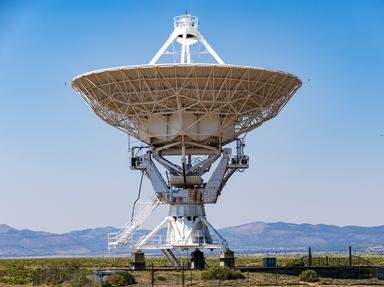
Telescopes are typically tasked to different parts of the spectrum of light. The Einstein Probe focuses on X-Rays. The VLT covers from near-ultraviolet, through visible light, to the mid-infrared. Hubble is primarily a visible light instrument.

The EHT is a collection of eight synchronized radio observatories stationed around the globe(Chile-2, Spain, Mexico, Arizona (U.S.), Hawaii-2, South Pole). This setup allowed the aperture of the lens (the hole that lets the light in) to be the size of the earth. It needed to be that big to have any chance at seeing something 55 million light years distant with any clarity.
6. Only certain types of stars have a chance to become a black hole. Our Sun doesn't quite fit the bill. Why will our Sun never become a black hole?

Answer: Our Sun is too small

The minimum size required for a star to become a black hole is about 20 times the mass of the Sun. Anything smaller simply doesn't have enough mass crashing down after a supernova to overcome the core of the star pushing back. The smaller stars become either white dwarfs or neutron stars.
7. A teaspoon sized sample of which kind of star could weigh the same as Mount Everest?

Answer: neutron star

Neutron stars are what you can get if a star isn't large enough to crash all the way down to a black hole. For example, a star that is about eight times the mass of our Sun will crash all the way down to a ball of neutrons about 20 km (or 12 miles) in diameter. That is how you get such enormous density.
8. To the ancient Greeks, which of the following was NOT a planet?

Answer: Earth

The Greek term, planetae, meaning "wanderers", is the source of the English term planet. Anything that moved across the sky, was a planet. Earth was considered stationary, hence, not a planet.

The Greeks had seven items they believed to be planets (in the order they believed them to be from Earth); the Moon, Mercury, Venus, the Sun, Mars, Jupiter and Saturn.
9. It is largely accepted that there are four fundamental forces in the universe. Which of these forces is the strongest?

Answer: Strong Force

Contrary to popular belief, gravity is an extremely weak force relative to the others as its value is dependent on the mass of the objects involved. The weak force helps drive radioactive decay. The strong force is what holds quarks together to make protons and neutrons. To put some numbers with it, the strong force is about million times stronger than the weak force and a ten followed by thirty-eight zeros times stronger than gravity.
10. While being pulled into a black hole, what is the culinary-inspired name for what the extreme tidal forces would do to your body?

Answer: Spaghettification

The gravity in a black hole is so extreme that the difference in gravitational forces between your feet and head will be enough to snap you in half. As you travel down, this process repeats until you are just a stream of particles headed towards the singularity.
Source: Author Jyrosolve

This quiz was reviewed by FunTrivia editor rossian before going online.
Any errors found in FunTrivia content are routinely corrected through our feedback system.
6/11/2026, Copyright 2026 FunTrivia, Inc. - Report an Error / Contact Us