FREE! Click here to Join FunTrivia. Thousands of games, quizzes, and lots more!
Quiz about Mohs Likely to Succeed

Mohs Likely to Succeed Trivia Quiz

10 Collectible Rocks and Minerals

This photo-quiz features ten questions about commonly hounded rocks by those who would call themselves rockhounds. Enjoy!
This is a renovated/adopted version of an old quiz by author Flynn_17

A photo quiz by JJHorner. Estimated time: 3 mins.
  1. Home
  2. »
  3. Quizzes
  4. »
  5. Hobbies Trivia
  6. »
  7. Collectibles

Author
JJHorner
Time
3 mins
Type
Photo Quiz
Quiz #
64,507
Updated
Mar 04 26
# Qns
10
Difficulty
Easy
Avg Score
9 / 10
Plays
158
Last 3 plays: treardon (10/10), Bobby Gray (7/10), AMATISTA (7/10).
-
Question 1 of 10
1. What mineral is famous for splitting into thin, bendy sheets that can often be peeled apart with your fingernail? Hint


Question 2 of 10
2. While known to some for its metaphysical healing powers, this incredibly common mineral comes in clear, rose pink, smoky brown, and many other varieties. What is it? Hint


Question 3 of 10
3. Which shiny, brassy mineral is often called "fool's gold" and charms beginning rock collectors with its metallic sparkle? Hint


Question 4 of 10
4. Which purple variety of quartz and February's birthstone is especially popular in geodes and jewelry displays? Hint


Question 5 of 10
5. Which mineral is loved by collectors for its wide range of colors and its tendency to glow under ultraviolet light? Hint


Question 6 of 10
6. Which banded, often translucent stone is a variety of chalcedony and commonly polished into slices and cabochons? Hint


Question 7 of 10
7. Which opaque, often red, yellow, or brown stone is a colorful variety of chalcedony prized for carving and cabbing? Hint


Question 8 of 10
8. This mineral earns a nine on the Mohs scale of hardness and includes the gemstone varieties ruby and sapphire. What is it? Hint


Question 9 of 10
9. What deep blue copper mineral forms charming crystal clusters but is relatively soft and needs to be handled gently? Hint


Question 10 of 10
10. Which mineral fizzes weakly in acid and is closely related to calcite, sometimes forming pink or tan crystals? Hint


(Optional) Create a Free FunTrivia ID to save the points you are about to earn:

arrow Select a User ID:
arrow Choose a Password:
arrow Your Email:


View Image Attributions for This Quiz

Most Recent Scores
Mar 20 2026 : treardon: 10/10
Mar 17 2026 : Bobby Gray: 7/10
Mar 17 2026 : AMATISTA: 7/10
Mar 15 2026 : Guest 174: 8/10
Mar 12 2026 : catnlib: 10/10
Mar 12 2026 : Guest 72: 5/10
Mar 11 2026 : dmaxst: 10/10
Mar 11 2026 : Guest 98: 8/10
Mar 11 2026 : Mad-martigan: 8/10

Quiz Answer Key and Fun Facts
1. What mineral is famous for splitting into thin, bendy sheets that can often be peeled apart with your fingernail?

Answer: Mica

Mica is the common, shiny, flaky Post-it Note of rocks and minerals. And it does split into thin sheets so easily that you can sometimes peel layers apart with a fingernail. This is due to its perfect basal cleavage. That means it has strong bonds within each sheet and very weak bonds between the sheets. (You can only imagine my disappointment when I googled a phrase with "cleavage" in it and got THAT mess.)

Those sheets are flexible, elastic, and really tough to break, at least if that's your goal. Bend them and they spring right back. That's the basal cleavage again: the bonds within each sheet are strong.

There are several types of mica, including muscovite and biotite, and they show up in igneous and metamorphic rocks all over the place. Historically, mica was used as a heat-resistant window in old stoves and lanterns before modern glass took over, which I'm still having trouble picturing.

Today it pops up in electronics, cosmetics, and even car paint, adding a little shimmer to stuff like eye shadow and automotive finishes. Next time something seems suspiciously sparkly, there's a decent chance that mica is hiding just behind the curtain.
2. While known to some for its metaphysical healing powers, this incredibly common mineral comes in clear, rose pink, smoky brown, and many other varieties. What is it?

Answer: Quartz

If your spouse has too many outfits, you'll likely be familiar with quartz's basic strategy, because it has a color for every occasion. There's clear quartz, rose quartz, smoky quartz, amethyst, citrine, and on and on and on. Chemically it's simply silicon dioxide, but visually it runs the full fashion spectrum. And because it is so abundant in Earth's crust, it shows up everywhere from mountain veins to beach sand to your kitchen countertop.

As for those alleged healing properties, quartz has been drafted into more crystal grids and moonlit charging rituals than it would probably like.

Scientists and engineers, however, treat it less like a mystical therapist and more like the very useful material it is. Quartz is crucial in electronics because of its piezoelectric properties. If that doesn't make sense to you, it just means it can generate an electric charge under mechanical stress.

And if that STILL doesn't make any sense, it's another way of saying if you press, bend, squeeze, or vibrate quartz, the atomic structure gets a little wacky, and an electric charge appears across the surface. The reverse is also true. That is, it can turn electricity back into that mechanical energy. We good now?

This is why quartz is good in watches (it vibrates precisely 32,768 times per second), microphones (sound waves press on the crystal, generating an electrical version of the sound), and various sensors because it converts motion into voltage.
3. Which shiny, brassy mineral is often called "fool's gold" and charms beginning rock collectors with its metallic sparkle?

Answer: Pyrite

It glitters. It gleams. It's broken more hearts than a vending machine that refuses to give out that Snickers you just paid for. Pyrite's been pranking prospectors for centuries with its flashy, aureate shine. The name comes from the Greek word 'pyr,' meaning fire, because it can spark when you hit it against steel. Handy if you're a caveman with some steel lying around, I guess.

Chemically speaking, pyrite is iron sulfide, not gold at all. Real gold is soft and can be scratched or dented fairly easily. Pyrite is brittle and will shatter if you whack it hard enough. It also tends to form neat little cubes, which look pretty architectural for something you just found lying in the dirt.
4. Which purple variety of quartz and February's birthstone is especially popular in geodes and jewelry displays?

Answer: Amethyst

Amethyst has been a big deal since ancient times, when you could find it hanging around in royal crowns and church rings. Its purple color comes from tiny traces of iron within the quartz crystal, plus a bit of natural radiation over geologic time. Yeah, everybody has a dramatic backstory. The shades range from pale lavender to deep royal purple, and the richer the color, the more collectors salivate.

It's also the February birthstone, which means people born in the shortest month of the year at least get one of the prettiest gems. Amethyst often forms inside geodes, those shy rocks that crack open like an egg to reveal a glittery crystal yolk.

Brazil and Uruguay are especially famous for producing massive amethyst geodes that look like portals to another world... or my bedroom, which my wife and I decided to paint purple for some reason. And while it used to be considered as valuable as ruby or sapphire, huge deposits discovered in the 19th century tipped the supply side in favor of affordability. Good news if you're into amethyst jewelry. Slightly less thrilling for any monarch wearing a previously priceless amethyst crown.
5. Which mineral is loved by collectors for its wide range of colors and its tendency to glow under ultraviolet light?

Answer: Fluorite

Fluorite is another mineral with a big wardrobe. It shows up in purple, green, blue, yellow, pink, clear, and sometimes all of the above in one neat little cube. Collectors love it because it forms crisp, geometric crystals that look like they were drawn by the spoiled kid with the BIG crayon set. You know, the one with 64 colors and a built-in crayon sharpener.

Then there's the party trick. Under ultraviolet light, many fluorite specimens glow in brilliant blues, purples, or other nifty shades. In fact, the word 'fluorescence' was named after fluorite. The glow happens because certain impurities in the crystal absorb UV light and re-emit it as visible light. Switch off the blacklight and it demurely returns to its regular weird self.

Beyond display cases, fluorite has had serious jobs too. It has been used as a flux in metal smelting, if that's your thing, and is a source of fluorine for industrial chemicals. Still, it's the glow-in-the-dark magic that wins the hearts and minds of rockhounds.
6. Which banded, often translucent stone is a variety of chalcedony and commonly polished into slices and cabochons?

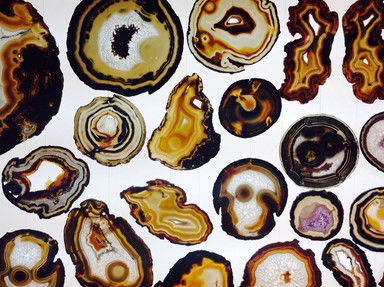
Answer: Agate

Agate forms in layers, usually inside volcanic rocks, as silica-rich water slowly deposits band after band of microcrystalline quartz. It sounds more romantic than it is. Slice one open and you get ribbons, eyes, waves, and swirls that look like abstract art. No two pieces are quite alike, which keeps collectors happily digging, polishing, and bragging to their patient wives.

Because it is fairly hard and durable, agate polishes up nicely. That is why you so often see it cut into smooth cabochons for jewelry or sliced into thin panels that glow when light shines through them (see image) in the event you're the kind of person looking to spend thousands on a wall hanging.

Some varieties are naturally colorful, while others have been dyed for extra drama, which seems a little unnecessary. Either way, it has been used for thousands of years in beads, seals, and other ornamentation.
7. Which opaque, often red, yellow, or brown stone is a colorful variety of chalcedony prized for carving and cabbing?

Answer: Jasper

Jasper tends to show up in bold reds, mustard yellows, earthy browns, and sometimes in funky landscape patterns that look like tiny desert sunsets. Unlike its translucent cousin agate, jasper is opaque. It has mineral impurities that give it both its color and its solid, paint-like appearance. Iron is usually the culprit in the classic red shades.

Because it's tough and takes a nice smooth polish, jasper has long been a favorite for carving, beads, and cabochons. Ancient cultures used it for seals and amulets, and it even appeared in texts from Mesopotamia and ancient Egypt through ancient Israel and Viking Age Scandinavia.

These days, rock shops are full of named varieties like "picture jasper" and "brecciated jasper", each with its own patterns and personal fan club.
8. This mineral earns a nine on the Mohs scale of hardness and includes the gemstone varieties ruby and sapphire. What is it?

Answer: Corundum

Corundum is the big man on campus here in this quiz, scoring a nine out of ten on the Mohs hardness scale. That makes it incredibly resistant to scratching, which is why both ruby and sapphire are not only pretty but also extremely durable for everyday jewelry. When corundum contains chromium, it turns red and earns the name ruby. Other trace elements like iron and titanium create the wide spectrum of sapphire colors, from deep blue to pink, yellow, and even green.

Outside of the jewelry box, corundum lives a very blue-collar existence. Hard as... well, a rock, I guess, it's been used as an abrasive in sandpaper and grinding wheels. Industrial grade corundum may not be all sparkly and pretty in a velvet box, but it does get the job done.

The gem-quality crystals have been treasured for centuries, appearing in royal regalia and engagement rings alike. Pretty varied résumé for aluminum oxide crystals.
9. What deep blue copper mineral forms charming crystal clusters but is relatively soft and needs to be handled gently?

Answer: Azurite

Azurite looks like it was painted with the richest blue ink you can imagine. Its intense color comes from copper, and when it forms sharp, glassy crystals in clusters, collectors tend to hover over the display case like doting parents. It is gorgeous. It is dramatic. It is also a bit fragile. With a Mohs hardness of only about 3.5 to 4, azurite scratches easily and can crumble if treated roughly. Don't toss it in your pocket with the car keys.

It often forms alongside its green cousin, malachite, and the two sometimes grow together in swirling blue and green combinations that look like some form of modern ocean art.

Historically, azurite was ground into pigment and used in paintings before modern synthetic blues took over. Over time, it can even alter into malachite through natural chemical processes. It's beautiful, but high maintenance.
10. Which mineral fizzes weakly in acid and is closely related to calcite, sometimes forming pink or tan crystals?

Answer: Dolomite

Dolomite is a low-key cousin of calcite. Drop a bit of cold, dilute hydrochloric acid on calcite and it dances naked through its living room. Try the same trick on dolomite and it clears its throat and blinks at you a couple of times... or sometimes nothing at all unless the mineral is powdered first. Geologists really seem to like this contrast. Personally, the only hydrochloric acid I have on hand is digesting my chicken tikka masala, and I'd personally like it to remain in my stomach where it belongs.

Chemically, dolomite is calcium magnesium carbonate, while calcite is just calcium carbonate. That extra magnesium changes the behavior and makes dolomite special, at least according to dolomite. It often forms in sedimentary environments, and the rock 'dolostone' is made primarily of this mineral.

The crystals can be colorless, but pink and tan shades are common, and occasionally you will find curved crystal faces that look like they were gently inflated. Subtle. Slightly fancy. And just reactive enough to say, "Oh, hey. That was kinda cool."
Source: Author JJHorner

This quiz was reviewed by FunTrivia editor Bruyere before going online.
Any errors found in FunTrivia content are routinely corrected through our feedback system.
3/25/2026, Copyright 2026 FunTrivia, Inc. - Report an Error / Contact Us