FREE! Click here to Join FunTrivia. Thousands of games, quizzes, and lots more!
Quiz about More Tales of Kingdoms

More Tales of Kingdoms Trivia Quiz

Old, Middle, or New?

In 1845 a German scholar, Baron von Bunsen, suggested that ancient Egypt's long history could be divided into different time periods in order to characterize similar periods of stability and accomplishments versus periods of chaos and war.
This is a renovated/adopted version of an old quiz by author jdiel

A classification quiz by ponycargirl. Estimated time: 3 mins.
  1. Home
  2. »
  3. Quizzes
  4. »
  5. History Trivia
  6. »
  7. Ancient History
  8. »
  9. Ancient Egypt

Author
ponycargirl
Time
3 mins
Type
Classify Quiz
Quiz #
70,325
Updated
Jun 12 26
# Qns
12
Difficulty
Average
Avg Score
8 / 12
Plays
43
Last 3 plays: DeepHistory (12/12), stephedm (12/12), abbymae01 (2/12).
While subsequent historians may have shifted events from one period to another, Baron von Bunsen's general idea took hold, and the timeline of ancient Egyptian developments still includes different groupings according to his suggestion. See if you can sort the information given into the Old, Middle, or New Kingdoms.
Old Kingdom
Middle Kingdom
New Kingdom

Policy of co-regency introduced Ahmose I drove out the Hyksos invaders Ramses II supported monumental building projects Also called Empire Period Also called Classical Age Theocratic monarchy began Thebes first became capital Imhotep was vizier Neferusobek was first female pharaoh Also called Age of Pyramids Memphis was capital Amarna Period took place

* Drag / drop or click on the choices above to move them to the correct categories.


Most Recent Scores
Jun 29 2026 : DeepHistory: 12/12
Jun 28 2026 : stephedm: 12/12
Jun 24 2026 : abbymae01: 2/12
Jun 22 2026 : MacaroniTree: 4/12
Jun 22 2026 : daver852: 10/12
Jun 18 2026 : Guest 172: 8/12
Jun 17 2026 : Guest 75: 3/12
Jun 17 2026 : Guest 74: 10/12
Jun 16 2026 : Guest 68: 4/12

Quiz Answer Key and Fun Facts
1. Memphis was capital

Answer: Old Kingdom

The Early Dynastic Period (c. 3150-2686 BC), which followed the Predynastic Period (c. 6000-3150 BC), saw the unification of Egypt by King Narmer (Menes). At the time, there were two kingdoms - Upper Egypt was located south along the Nile River and Lower Egypt was located at the Nile Delta.

Narmer choose the city of Memphis as his capital because it was located at the point of the unification of both kingdoms, and it remained the capital for about 1500 years. Its location at the crossroads of the two kingdoms allowed the pharaoh complete control of the newly unified country.

Also an important religious center, Memphis was the home of the god Ptah, who was the god of creation and patron of artists and craftsmen. The Great Temple of Ptah was a major site for pilgrims who traveled to the ancient city. It was the place where pharaoh was crowned, where religious festivals were held, and where Ptah's consort, Sekhmet, and son, Nefertem, were also honored.
2. Imhotep was vizier

Answer: Old Kingdom

The vizier was the highest government official in ancient Egypt, serving as pharaoh's right hand man or prime minister. He oversaw virtually every aspect of life, including the activities of lesser officials, tax collectors, and judges. Second in power only to pharaoh, the vizier also oversaw the entire economy, served as the supervisor of building projects, and ran the royal household.

Imhotep lived from approximately 2667-2600 BC, during the Third Dynasty at the beginning of the Old Kingdom. He is believed to have been very accomplished, especially as an architect and healer. Imhotep is credited with the construction of a pyramid for Pharaoh Djoser at Saqqara, which is about 52 miles (31.7 km) south of Cairo today. His step pyramid is considered to be first one ever built. It is the world's oldest known monumental stone building and the first known use of formed stone columns to support a building.

Imhotep also served as the court doctor to Djoser. After his death Imhotep eventually became revered as the god of medicine. Over thousands of years, as he was deified, his cult eventually merged with that of the god Thoth. Imhotep was one of just a couple of ancient Egyptian commoners who was over time fully deified.
3. Theocratic monarchy began

Answer: Old Kingdom

Throughout its long history, ancient Egypt's government was a theocratic monarchy. The government was ruled by a pharaoh, who, as a living god on earth, held complete power. There was no separation of church and state; the pharaoh was the supreme authority over everything, including the military, laws, court system, and building projects. In addition, he was the intermediary between the people and their gods, responsible for maintaining ma'at, the cosmic order of things. While it took an enormous bureaucracy of officials to manage everything, the pharaoh always had the final, most important opinion.

It must be noted here that the king of ancient Egypt wasn't always called pharaoh, although historians use the term to apply to every Egyptian king. During the Old Kingdom, the term, which originated from "per-aa", meaning great house, was used to identify the king's household and administration. The traditional word for king was "nesut", which was used along with different royal titles. It was not until well into the New Kingdom that some began to use the term pharaoh.
4. Also called Age of Pyramids

Answer: Old Kingdom

Life for the ancient Egyptians was pretty quiet during the Old Kingdom. Protected by natural barriers - the Mediterranean Sea, and the harsh desert, they were secure from outside intervention. Not only that, but the people had everything they needed. There was plenty of food that was made possible by the annual flood of the Nile, and lots of seasonally unemployed farmers and skilled workers who were willing and able to work on building projects that glorified their gods - or whatever else their divine ruler asked them to do.

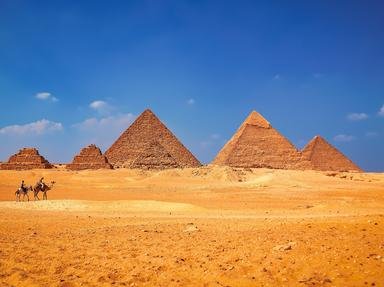
So there was plenty of time to focus on the construction of monumental buildings, which, of course, we know the ancient Egyptians did; many of the pyramids were built during this time of separation from the rest of the world. Most famously, the Step Pyramid of Djoser (c. 2667 BC-2648 BC), and the pyramids on the Giza Plateau - the Pyramids of Khufu, Khafre, and Menkaure (c. 2600 BC-2500 BC) - were built during the Old Kingdom, along with some experimental structures, like the Red Pyramid and Bent Pyramid at Dahshur.

The Old Kingdom, or the Age of Pyramids, included Dynasties 3-6, and lasted from approximately c. 2686-2181 BC. By the time of its demise, royal authority had declined and local governors called nomarchs became more powerful. Egypt entered into a phase called the First Intermediate Period that included Dynasties 7-10, and lasted from c. 2181-2055 BC. It was a time that was characterized by civil war and famine.
5. Neferusobek was first female pharaoh

Answer: Middle Kingdom

The Middle Kingdom, which existed from c. 2055-1650 BC, was a period of reunification that included just two ruling families - Dynasties 11 and 12.

Neferusobek, who is also called Sobekneferu, ruled Egypt for almost four years as the last pharaoh of the Twelfth Dynasty. Although there were technically female rulers before her, Neferusobek fashioned herself as the Daughter of Re and Female Horus in order to let it be known that she was the full ruler of Egypt; this unprecedented move is why she has the notoriety of being the first female pharaoh.

It is not known exactly how Neferusobek became pharaoh. Perhaps there was no male heir left in her family, or maybe she believed the ones who were left were unfit to rule and simply seized the throne. It appears that she claimed her legitimacy to rule from her father, Amenemhat III, rather than her predecessor, Amenemhat IV, who is presumed to have been her brother/husband.

During her reign, Neferusobek completed her father's mortuary temple, and made certain that he was deified. An inscription found at Kumma, which is in Sudan today, confirms her reign throughout ancient Egypt.
6. Thebes first became capital

Answer: Middle Kingdom

Thebes was an ancient city that was founded in Upper Egypt in approximately 3200 BC. (Remember: Because of the way the Nile River flows, Lower Egypt was in the North around the Nile Delta and Upper Egypt was further south along the Nile). It began as a small farming community and trading post, but historians believe that by c. 1800 BC its population was larger than Memphis, and for a time it was the largest city in ancient Egypt.

About 2050 BC Mentuhotep II, a prince from Thebes, reunited Egypt after the First Intermediate Period and began the Middle Kingdom, using the city as a base for his power. His political success also elevated the status of the patron deity of Thebes, Amun, who, over time, became one of the most important gods in all of Egypt. This connected pharaoh to the god, and solidified his divine nature in the eyes of the people as he became the son of Amun. During the Middle Kingdom, therefore, Amun or Amun-Ra, began his ascent, moving up the Egyptian pantheon of gods, to become more important during the New Kingdom.

The seat of government changed many times during Egyptian history, however, during the Middle Kingdom it was moved for the first time to Thebes. Today the modern city is called Luxor.
7. Also called Classical Age

Answer: Middle Kingdom

Pyramids were quite spectacular, but after a few of them were constructed scholars apparently found them to be rather redundant! Let's hear it for some artistic change during the Middle Kingdom!

During this time, written language became codified, with hieroglyphics being used for religious texts and hieratic, a cursive script, being used for other documents. This resulted in the Middle Kingdom becoming a golden age of literature with the addition of poetry, essays, and stories rather than just the usual funeral texts that were being created. "The Story of Sinuhe", about the adventures of an official who fled Egypt after the pharaoh was assassinated, and "The Tale of the Shipwrecked Sailor", about the last survivor from a shipwreck, are considered to be two of the era's literary masterpieces.

Also during the Middle Kingdom, the style of art in sculpture became less rigid and formal. Instead of representing the pharaoh with young, flawless looking statues, artists created more realistic ones, that show wrinkles and individual differences. Block statues, with the person squatting with his knees pulled up to his chest and his arms folded, also became popular during this time.
8. Policy of co-regency introduced

Answer: Middle Kingdom

Finding the key to an uneventful, peaceful succession after the death of the pharaoh was difficult, and could cause some rather unstable times, but Amenemhat I, who reigned from 1991-1962 BC, tried a system that is called co-regency today. In this system, the ruler would essentially choose his successor, rather than risk experiencing a power struggle upon his death, and while the old king maintained his divine power, the young king in training prepared to assume the role. This did not become a standard practice for all time to come; however, it was successfully used from time to time.

By approximately c. 1650 BC, Egypt's Classical Age was over, and the Second Intermediate Period (c. 1650-1550 BC) began. Dynasties 13-17 ruled during this time, which was a period of great instability.
9. Also called Empire Period

Answer: New Kingdom

During the Old and Middle Kingdoms, Egypt remained mostly isolated from its neighbors, focusing instead on its cultural development. That policy changed after the land had been ruled by the Hyksos invaders for nearly 100 years during the Second Intermediate Period. Buffers that were not just geographical features were needed to protect the borders. In addition, foreign trading became more profitable and control of the trade routes gave Egypt valuable resources like gold and cedar trees.

Thutmose III (c. 1481-1425 BC), a pharaoh of the 18th Dynasty, is credited with expanding the empire of ancient Egypt to its fullest extent, including parts of modern day Sudan south along the Nile River, and Israel, Syria, and Lebanon to the Euphrates River. At its peak the empire stretched 1500 miles, and connected Africa with the modern day Middle East.
10. Ramses II supported monumental building projects

Answer: New Kingdom

A pharaoh of the 19th Dynasty, Ramses II, or the Great as he is sometimes called, is known today for his building projects, use of propaganda, and longevity. He lived over 90 years and ruled Egypt for 66 of them, leaving behind an estimated 100+ children.

His colossal statues - of himself, of course! - are found all over Egypt. In addition, he commissioned more building projects that any other pharaoh in Egypt's long history. Perhaps his most famous are the Temples of Abu Simbel and Karnak.

Abu Simbel was built out of the rock cliffs that were close to Egypt's modern border with Sudan. It featured four colossal statues of the pharaoh and some smaller statues of his wife, Nefertari. Two days each year, about thirty days before the equinoxes, the sun's rays would illuminate the interior of the temple. When the Aswan Dam was created in 1964, the United Nations undertook a project to carve the temple out of the cliffs and reassemble the pieces on higher ground.

The Temple Complex at Karnak, built to honor Amun-Re, is the largest religious building complex ever constructed. Built over a period of 2000 years by an estimated 30 different pharaohs, the main focal point of the complex is the Great Hypostyle Hall; the room measures 54,000 square feet and is supported by 134 sandstone columns, some as tall as 70 feet. Ramses went about completing the Great Hypostyle Hall by adding his own statues and decorating the columns. He recorded his great victory over the Hittites at the Battle of Kadesh on the southern exterior wall of the hall.

Modern archaeologists have discovered, however, that perhaps Ramses wasn't as great as he wanted people to believe! He tended to stretch the truth a bit far as times; for example, the Hittites also claimed to have won the Battle of Kadesh, and his name has been found on many monuments that were built by earlier pharaohs. Nevertheless, his reign is still pretty impressive!
11. Amarna Period took place

Answer: New Kingdom

Pharaoh Amenhotep IV of the 18th Dynasty is well known for trying to change the religious beliefs of the ancient Egyptians. After he became pharaoh, he changed his name to Akhenaton, which means the glory of the Aton. He tried to convince the people that Aton, symbolized by the solar disk, was the only true god.

This period in Egyptian history is called the Amarna Period (c. 1353-1320 BC) because Akhenaton moved his capital to the city of Tell el-Amarna, a site which was about half-way between Memphis and Thebes. He built temples to honor Aton there, as well as a great palace, banqueting hall, and a village for workers. At its peak the city was located along an eight mile (13 kilometers) stretch of the bank of the Nile River and had an estimated population of 20,000-30,000 people.

After Akhenaton's death, his city was abandoned and his beliefs were forgotten. He had neglected the empire and there was work to be done. His family, first Smenkhkare and later, Tutankhamun, had to figure out how to placate the priests of Amun-Re and the people who had their lives turned upside down by the religious turmoil.
12. Ahmose I drove out the Hyksos invaders

Answer: New Kingdom

Toward the end of the Middle Kingdom, the Twelfth Dynasty collapsed only to be succeeded by an even weaker Thirteenth Dynasty. The strong central government became fragmented and Egypt was no longer a unified kingdom. To make matters worse, the Hyksos, believed to have been a group of Asiatic people, invaded the area around the Nile Delta. They had better weapons than the ancient Egyptians who were slow to adopt new technology, and had horse drawn battle chariots, which they Egyptians had probably never seen.

There is no historic writing that explains exactly how it happened, but the Hyksos were able to establish a kingdom there, assimilating their culture with ancient Egyptian customs, and ruling the land for about 100 years. In fact, the Hyksos ruler was even crowned pharaoh in spite of the fact that the Egyptians already had one.

After a time, the Egyptians began to feel a bit wedged in between the Hyksos to the north and the Nubians to the south. Pharaoh Kamose planned to free Egypt of the Hyksos, and his brother Ahmose finally succeeded, becoming the first pharaoh of the 18th Dynasty of the New Kingdom (c. 1550-1069 BC). Dynasties 18-20 would rule during this time.
Source: Author ponycargirl

This quiz was reviewed by FunTrivia editor trident before going online.
Any errors found in FunTrivia content are routinely corrected through our feedback system.
6/30/2026, Copyright 2026 FunTrivia, Inc. - Report an Error / Contact Us